Disclaimer:
[ The information in this article is for educational purposes only and does not replace professional, hands-on motorcycle training. Riding on mountain roads involves inherent risks. Always consult certified riding instructors and verify safety techniques with official motorcycle safety organizations before attempting challenging routes.]
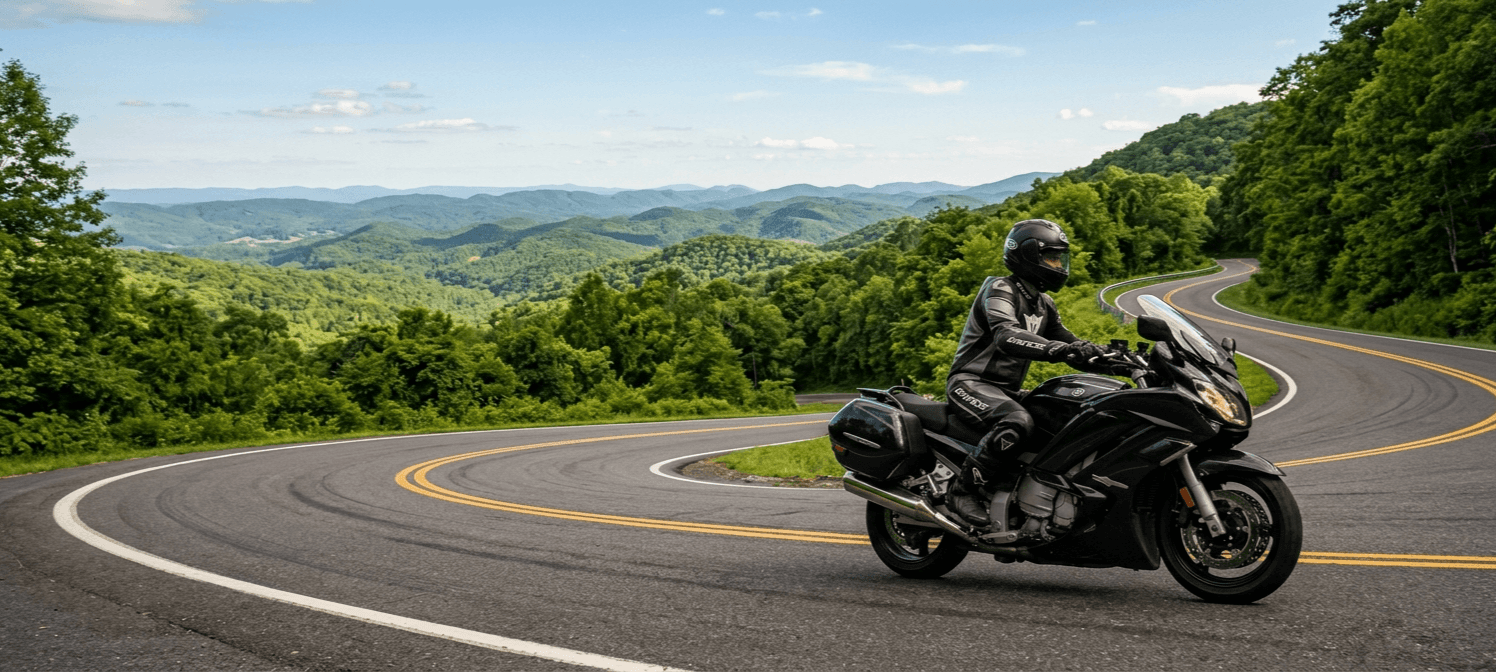
There is a unique thrill that comes with turning your motorcycle into a sharp mountain bend, feeling the suspension compress, and leaning with the machine as the road sweeps around a cliffside. Virginia’s backroads, from the sweeping vistas of Skyline Drive to the tight switchbacks of the Blue Ridge Parkway, offer some of the finest riding in North America. These asphalt ribbons cut through the Appalachian Mountains, promising pure freedom to anyone on two wheels.
However, these breathtaking scenery demands a high level of skill. Mountain curves are vastly different from flat highway cruising; they feature unpredictable elevation changes, blind corners, and shifting traction levels that can catch even experienced riders off guard. One wrong entry speed or a sudden panic brake can quickly turn a perfect weekend ride into a dangerous situation. To ride these scenic routes safely and confidently year after year, you must master the fundamental physics of cornering. In this guide, we break down the essential techniques that will help you conquer the curves, protect your line, and navigate Virginia’s finest twisties with absolute control.
Understanding Body Position in Corners
The way you position your body on the motorcycle directly impacts how the bike handles a turn. Proper body position reduces the lean angle required to make a corner, leaving you with more tire traction and a safer margin for error.
To achieve the correct position, avoid fighting the motorcycle’s natural lean. Keep your spine aligned with the bike or lean slightly into the turn, moving your upper body toward the inside mirror. Relax your arms and keep your elbows bent; stiff arms absorb road bumps poorly and restrict steering inputs. Finally, keep your knees tucked tightly against the fuel tank to stabilize your lower body and maintain a firm connection with the machine.
The Importance of Target Fixation
One of the most critical psychological aspects of cornering is where you direct your eyes. A phenomenon known as target fixation causes a rider to steer toward whatever they are looking at. If you stare at a guardrail, a pothole, or the edge of the road, your motorcycle will naturally drift toward that hazard.
To corner safely, you must actively train your vision to look through the turn. Keep your head up and look as far ahead as possible toward the exit of the curve, not at the pavement immediately in front of your front tire. By looking where you want to go, your brain automatically calculates the correct path and lean angle, allowing you to navigate sharp bends smoothly and avoid sudden panics.
Throttle and Brake Control
Managing your speed is the golden rule of mountain riding. Entering a corner too fast forces you to brake hard while leaning, which can destabilize the suspension and cause the tires to lose traction.
The correct technique follows a simple sequence: slow, look, press, and roll. First, reduce your speed using both brakes before you enter the turn while the motorcycle is still upright. Once you begin to press the handlebars to lean into the curve, ease off the brakes completely. Hold a steady throttle through the apex of the turn to keep the chassis stable. As you see the exit of the corner and begin to straighten the motorcycle, gently roll on the throttle to smoothly accelerate out of the bend.
Adapting to Virginia’s Elevation Changes
Virginia’s mountain roads are famous for their sudden elevation changes, which add another layer of complexity to cornering. Uphill curves require more throttle to maintain momentum, while downhill curves shift the motorcycle’s weight forward, reducing rear-wheel traction and increasing the braking load on the front tire.
When riding downhill, brake earlier and more progressively before the turn. Be prepared for blind crests where the road drops away suddenly, and look out for unexpected hazards such as loose gravel washed from hillsides, damp patches hidden under mountain shadows, or wildlife crossing the road. Adapting your speed to these natural elements ensures you stay in total control.
Safety First
Mastering mountain curves is a continuous journey that requires patience, practice, and the right mindset. No matter how experienced you become, always wear full protective gear, including a high-quality helmet, riding jacket, gloves, and sturdy boots. Never ride beyond your personal skill level or the limits of your motorcycle. By respecting the road and continuously refining your technique, you can enjoy the twists and turns of Virginia’s beautiful highways safely for many years to come.
Leave a Reply