[Disclaimer: This article is provided for informational and educational purposes only. Riding conditions and safety gear effectiveness vary significantly by region, speed, and individual experience level. Always exercise personal judgment, consult professional safety standards, and inspect your gear regularly before riding.]
The Armor Grid:
How to Choose CE-Rated Gear That Saves Your SkinMost riders think a heavy jacket is enough protection.
The smart rider knows it is the armor underneath that actually absorbs the impact.
Introduction:
Asphalt Doesn’t Forgive — Gear Up SmartSliding down the highway is an exercise in pure physics.
While an abrasion-resistant outer shell protects against road rash, it does absolutely nothing to stop the bone-shattering force of a direct impact with the ground or an obstacle.
Understanding how impact protection works technically is what separates a prepared rider from an unprotected one. This concise guide breaks down the technical world of CE ratings, impact zones, and smart materials so you can choose gear that delivers real protection.
1. What Does “CE-Rated” Actually Mean?
The “CE” stamp on motorcycle armor stands for *Conformité Européenne* (European Conformity).
It is the global gold standard for motorcycle safety testing.
Armor does not just look tough; it is scientifically tested in labs by dropping a heavy weight onto it to measure how much impact force is transmitted through the pad to your body.
The lower the force transmitted, the safer the armor is for your bones and joints.
2. CE Level 1 vs. CE Level 2:
The Technical DifferenceWhen shopping for motorcycle gear, you will encounter two main levels of impact protection:
* CE Level 1: This is the baseline standard for motorcycle protection. It is certified to transmit a maximum of 18 kN (kilonewtons) of force during testing.
It is thinner, lighter, and highly flexible—ideal for daily commuting and hot-weather riding.
* CE Level 2: This is high-tier protection. It is certified to transmit no more than 9 kN of force—offering double the impact protection of Level 1.
It is thicker and slightly heavier, making it the non-negotiable choice for high-speed track riding, highway touring, and adventure riding.
3. The Science of Smart Materials (D3O & Sas-Tec)
Traditional motorcycle armor used hard plastic shells backed by foam.
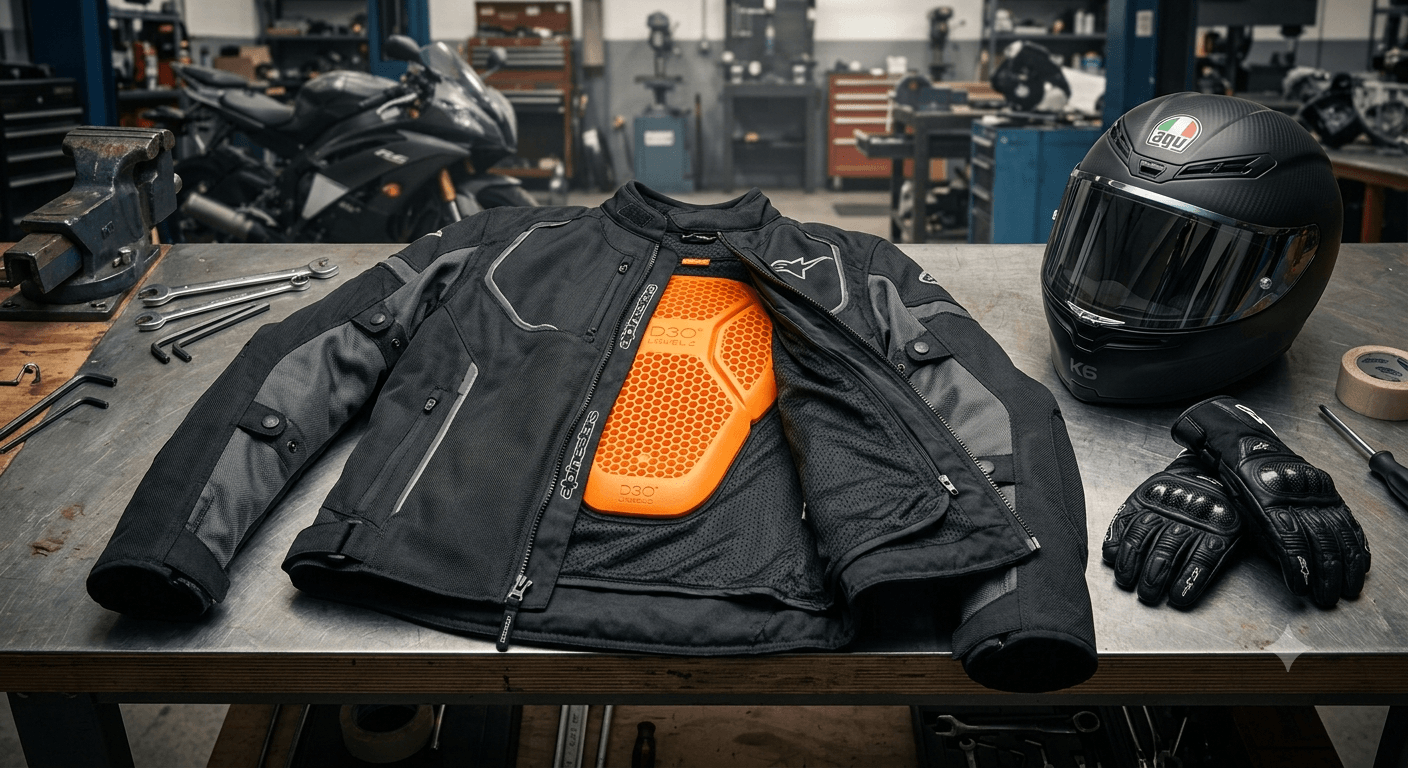
Modern high-tech gear uses advanced polymer matrices, often referred to as “smart materials” like D3O or Sas-Tec.
The physics behind smart materials is fascinating:
* At Rest: The molecules inside the pad flow freely, making the armor completely soft, flexible, and comfortable to wear while moving.
* On Impact: The moment a sudden force hits the pad, the molecules lock together instantly.
The soft pad transforms into a rigid, energy-absorbing shield in milliseconds, distributing the impact force away from your joints before returning to its flexible state.
4. Universal Armor Fit Principles
Even the most advanced CE Level 2 armor is useless if it shifts out of place during a crash. Keep these three structural placement rules in mind:
1. Perfect Alignment:
Ensure the built-in pockets position the armor directly over your joints (shoulders, elbows, knees, and hips).
2. Snug Fitment:
Your riding jacket and trousers must fit snugly.
If the jacket sleeves are too loose, the elbow armor will rotate away from your joint during a slide, leaving you unprotected.
3. Dedicated Back Protection:
Most jackets come with a useless thin foam pad in the back pocket.
Replace it immediately with a dedicated, thick CE Level 2 back protector.
Conclusion:
Invest in Your Safety, Not Just StyleStyle matters, but impact physics matters more.
When selecting your next riding kit, look past the brand logos and inspect the CE label inside the armor pockets.
Choosing the right level of protection ensures that if a sudden stop occurs, your gear does its job perfectly so you can ride another day.
Respect the physics.
Trust the ratings.
Ride prepared.
References & Sources :
* Motorcycle Safety Foundation (MSF) — Personal Protective Equipment Guidelines — msf-usa.org
* European Committee for Standardization (CEN) — EN 1621 Impact Standards — cen.eu
* National Highway Traffic Safety Administration (NHTSA) — Motorcycle Rider Gear Efficacy — nhtsa.gov
Leave a Reply